
There is some news regarding the applications I’m developing at the moment.
ProcessLama and GitLama go open-source
First, I decided to open-source my apps gradually.
I think this makes it easier to trust an application, and if one of the applications helps someone else, they can contribute and develop it further.
The first application that I deemed “ready” was ProcessLama.
The process of open-sourcing it went quite smoothly overall, with only a few bumps here and there.
The biggest effort was ripping out the Forgejo CI definition and adapting it to GitHub Actions. Moving from my custom runners at home to shared GitHub runners also caused a couple of changes in the general approach (mainly the release process).
You can find the code now here.
Shortly after that, the next application was open-sourced: GitLama.
Building on what we learned from ProcessLama, the process of open-sourcing it was even more straightforward.
You can find the code here.
So now you can have a look at the code, download it, change it, build something on top, or contribute back.
Other applications will follow once they reach a state that’s ready for open-sourcing.
Flutter and desktop
As written in this blog post, I did a quick detour to Qt and Rust to better support Linux systems and came back to give Flutter another chance.
This worked great, and ProcessLama and GitLama were open-sourced as Flutter applications.
Shortly after I open-sourced them, I decided to bump to the latest Flutter version (3.50). This worked great for macOS, but caused a whole new level of issues on Linux.
Just have a brief look at this video:
As you can see, the Flutter upgrade completely butchered the rendering integration on Linux - at least on Wayland (I didn’t test X11 or other distributions).
I did not want to create yet another Flutter engine patch that would even affect all applications. The patches I already had for MailLama (Linux webview support) and GitLama (macOS rendering issues) were already enough.
Another “solution” would have been to just switch back to Flutter 3.47 and hope that the Flutter team (or the Canonical team) fixes this Linux desktop integration issue for the next release.
Since I was already using Rust, I wondered if I could just use a native Rust UI library and do the full stack in Rust. To be really sure this works out, I decided to port MailLama first, as it is the technically most complex application I currently have.
I tasked an agent to do the conversion (and to fork + improve a webview integration) and it ran for days. It finally came up with an application that was quite nice and close to the Flutter version, so the direction looked promising - until I actually played around with it.
Because there is no mature webview integration yet, forking an experimental one and integrating it into MailLama led to all kinds of issues that you get when maintaining a low-level webview integration:
- scroll direction did not respect the system settings
- worked on AMD GPUs, but not on Intel GPUs
- had issues after resuming from suspend
- …
All of this was too much for me to use as a technological base for my desktop applications, so I decided to revive the Qt variants of my desktop applications, bring them to feature parity with the Flutter ones, and move forward with Qt and Rust.
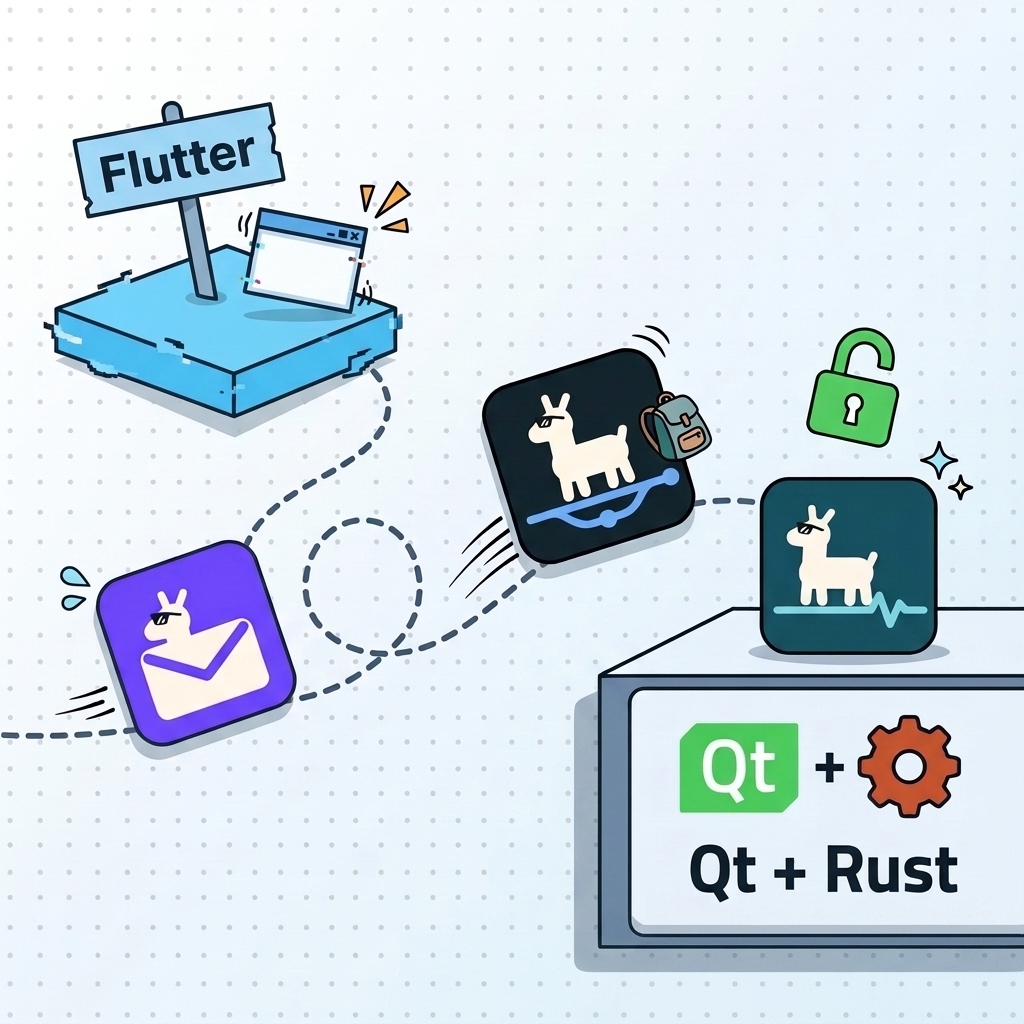
ProcessLama is already fully migrated and GitLama is in the process of it (basically ready, I’m just doing testing at the moment).
Maybe one day, when Flutter catches up and gets proper desktop - and especially Linux - support and love, I can start using it for desktop applications again.
Comments